Still Living, Still Tippin' no.6
Ali Alamdar- Price
- 120 KD
- Size
- 60 x 50 cm
- Type
- Modern
- Year
- 2025
- Medium
- Oil
Description
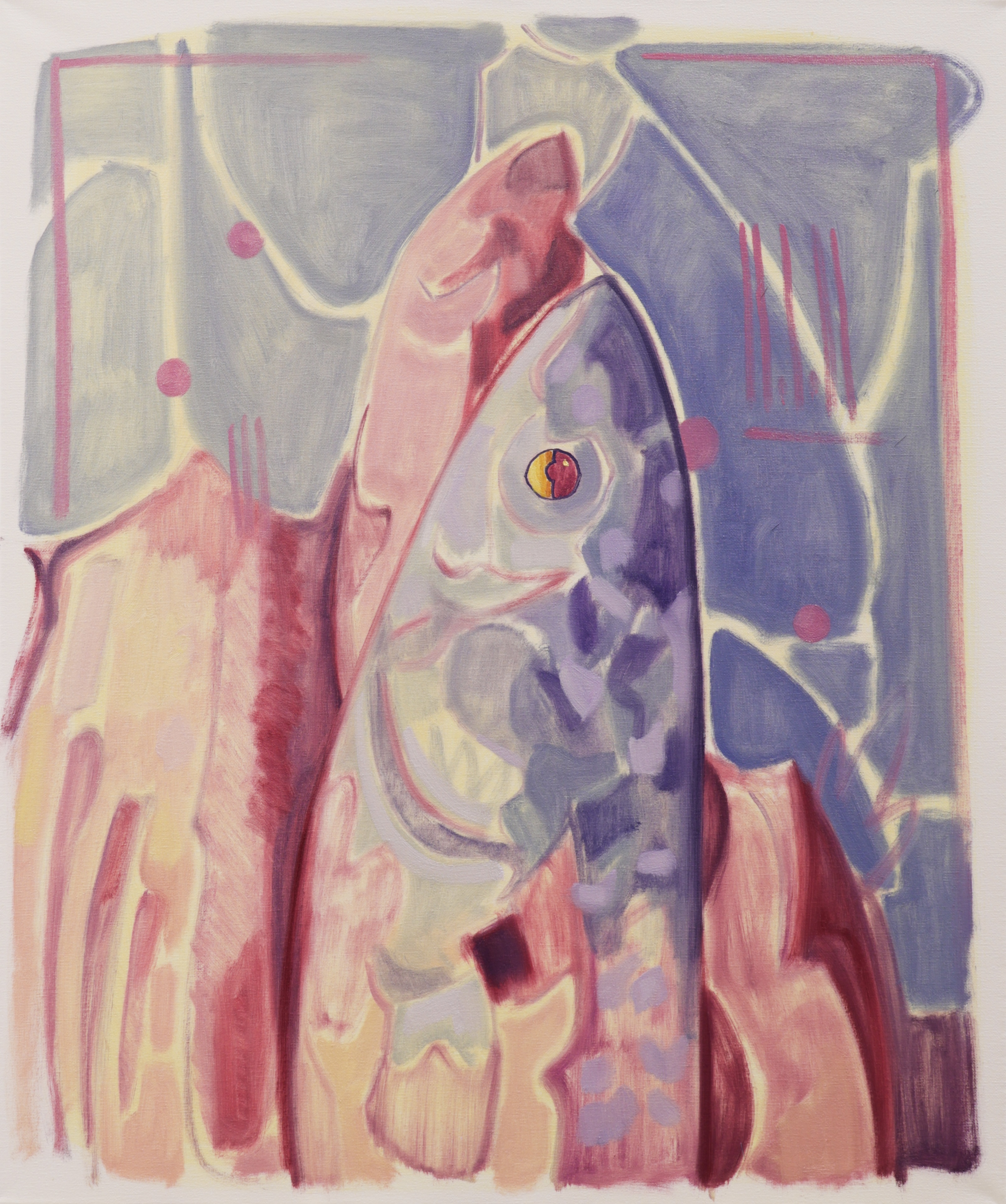
This work explores the tension between individuality and categorization. The painting originates from a fish market, a place where living organisms are gathered, sorted, priced, and presented as commodities. Hundreds of fish occupy the same space, stacked together until distinction dissolves and the individual disappears into the category. Rather than depicting the market as a whole, the work isolates a single fish from that system. The choice is deliberate. What was once part of a mass is returned to singularity, asking the viewer to confront one organism rather than an accumulation of many. The fish exists in an unstable position. It is both a living creature and a product awaiting consumption, conditions presented not as opposites but as realities that coexist within the same body. Its value as an organism has not vanished, yet it now sits within a structure that assigns value through utility and exchange. The work is not a critique of this transformation. Survival has always depended on such cycles. Instead, it examines how easily individuality is obscured once something is absorbed into a larger system. By isolating one fish from the countless others around it, the painting restores a sense of singular presence. For a brief moment, the fish becomes visible again as itself, no longer inventory, no longer a unit within a category. The work stays suspended between these conditions, asking where individuality ends and classification begins.
Other works by this artist